No products in the cart.
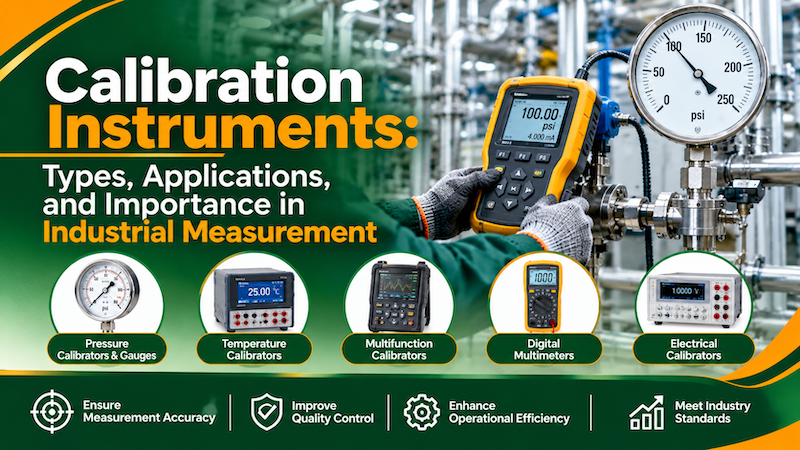
Calibration instruments are the foundation of accurate and reliable industrial measurement. Every pressure transmitter, temperature sensor, flow meter, and control loop in a plant depends on regular calibration to ensure that readings remain accurate over time. Without proper calibration, measurement drift can lead to poor product quality, energy waste, safety risks, and costly downtime. This article explains the main types of calibration instruments, their applications, and why they are essential in modern industrial facilities.
What Are Calibration Instruments?
Calibration instruments are test and measurement devices used to verify, adjust, and certify the accuracy of industrial instruments. They generate or measure precise reference signals—such as pressure, temperature, current, voltage, and frequency—and compare them with the output of the device under test. Regular calibration ensures traceability to national and international standards and keeps processes within specification.
Types of Calibration Instruments
Calibration instruments come in several categories, each designed for specific measurement tasks. Understanding the differences helps maintenance and metrology teams select the right tool for each job.
1. Multifunction Calibrators
Multifunction calibrators combine several calibration functions in a single portable device. They can typically source and measure electrical signals, temperature sensors, and sometimes pressure. This makes them highly versatile for field service and workshop use, reducing the number of tools technicians need to carry. Explore the full range of Multifunction Calibrators to compare models from leading brands.
2. Pressure Calibrators
Pressure calibrators are used to test and calibrate pressure gauges, transmitters, switches, and sensors. They generate precise pressure using pneumatic or hydraulic systems and often include built-in pressure modules for different ranges. Accurate pressure calibration is critical in oil and gas, water treatment, HVAC, and process industries. Browse the Pressure Calibrators collection for general, hydraulic, pneumatic, and laboratory-grade options.
3. Loop Calibrators
Loop calibrators are specialized for testing and troubleshooting 4–20 mA current loops. They can source and measure loop current, simulate transmitter output, and power the loop. These instruments are indispensable for commissioning and maintaining process control loops in PLC and SCADA-based systems. Discover reliable Loop Calibrators for field and workshop applications.
4. Temperature Calibrators
Temperature calibrators verify thermocouples, RTDs, and temperature transmitters using dry-block or liquid-bath technology. They provide stable and uniform temperature references for accurate sensor testing.
5. Deadweight Testers and Pressure Standards
For high-accuracy laboratory and primary pressure calibration, deadweight testers and pressure standards provide fundamental traceability based on physical principles rather than electronic sensors.
Applications of Calibration Instruments
Calibration instruments are used across nearly every industry that relies on measurement accuracy:
- Process industries — verifying pressure, temperature, flow, and level transmitters in chemical, petrochemical, and pharmaceutical plants.
- Oil and gas — calibrating pressure and flow instruments on pipelines, wellheads, and separation systems.
- Power generation — maintaining accurate measurement in boilers, turbines, and cooling systems.
- Water and wastewater — ensuring reliable level, flow, and pressure readings for treatment control.
- Manufacturing and factory automation — validating sensors and control loops connected to PLCs and SCADA systems.
- Metrology laboratories — providing traceable reference standards for accredited calibration work.
Why Calibration Instruments Are Important
Accuracy and Product Quality
Small measurement errors can cause significant quality problems in production. Regular calibration ensures that instruments provide accurate readings, keeping processes within specification and reducing waste.
Safety and Compliance
Many industries are governed by strict regulations and standards, such as ISO 9001, GMP, and OSHA requirements. Calibration records provide evidence of compliance and help prevent safety incidents caused by faulty measurements.
Reduced Downtime and Maintenance Costs
Calibration instruments allow technicians to detect drift early, troubleshoot loops quickly, and perform preventive maintenance. This reduces unplanned downtime and extends the life of expensive field instruments.
Energy Efficiency and Cost Savings
Accurate flow, pressure, and temperature measurements enable better process control, which directly reduces energy consumption and operating costs.
Traceability and Documentation
Professional calibration instruments generate certificates and records that support audits, quality management systems, and continuous improvement initiatives.
Choosing the Right Calibration Instruments
When selecting calibration instruments, consider the measurement parameters, required accuracy, portability, environmental ratings, and calibration traceability. For hazardous areas, choose intrinsically safe models. For multi-parameter work, multifunction calibrators offer the best flexibility, while dedicated loop or pressure calibrators provide focused performance for specific tasks.
Nani Rohaeti, based in Batam, Indonesia, supplies a comprehensive catalog of genuine calibration instruments from trusted brands such as Fluke, Druck, WIKA, PIE, and Extech. Browse the complete Calibration Instruments category to find the right tools for your metrology, maintenance, and commissioning needs, with competitive pricing and fast delivery across Indonesia and Southeast Asia.
Conclusion
Calibration instruments are essential for maintaining measurement accuracy, ensuring safety, and supporting quality management in industrial operations. By understanding the main types—multifunction, pressure, loop, and temperature calibrators—engineers and technicians can build a calibration program that protects their processes and delivers long-term reliability. Investing in high-quality calibration instruments is an investment in the accuracy and credibility of your entire measurement system.