No products in the cart.
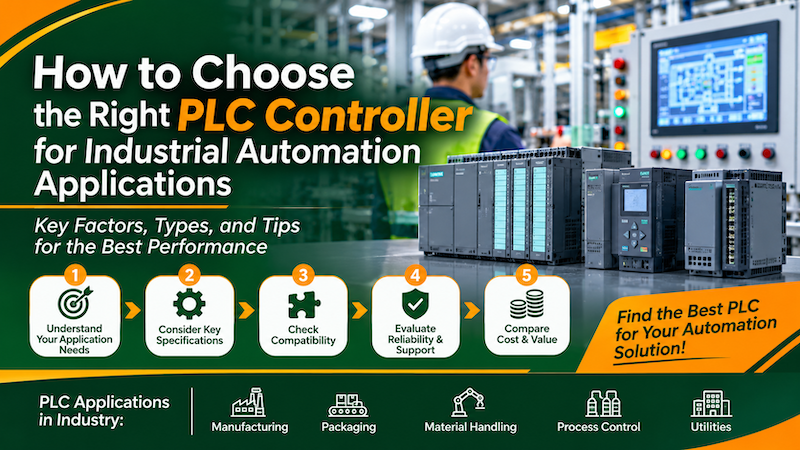
Choosing the right PLC controller is one of the most important decisions in any industrial automation project. The PLC (Programmable Logic Controller) is the brain of your control system, and the wrong choice can lead to unnecessary costs, limited scalability, and operational downtime. This guide walks you through the key factors engineers and plant managers should consider when selecting a PLC controller for industrial automation applications.
1. Understand Your Application Requirements
Before comparing models, define what your system actually needs to do. Consider the number of input and output points, the type of signals (digital or analog), required scan times, and whether the process involves motion control, safety functions, or simple on/off logic. A small machine may only need a compact micro PLC, while a large process plant may require a modular controller with extensive I/O expansion.
2. Digital vs. Analog I/O and Point Count
Estimate your current I/O requirements and add room for future growth. Digital I/O handles switches, relays, and sensors, while analog I/O is essential for temperature, pressure, flow, and other variable measurements. Modular PLCs allow you to add I/O modules as your system expands, which is often more cost-effective than replacing a fixed controller later.
3. Choose Between Local and Remote or SCADA-Based Control
Not every application is confined to a single control cabinet. For distributed assets such as water and wastewater networks, oil and gas pipelines, or remote power infrastructure, SCADA and RTU-based PLCs are the better fit. These rugged controllers support telemetry, secure communications, and remote data acquisition. If your project involves remote monitoring, explore the SCADAPack PLCs range, which is designed for reliable SCADA and remote telemetry applications.
4. Evaluate Communication and Integration Needs
Modern automation systems rarely operate in isolation. Check which protocols the PLC supports—such as Ethernet/IP, Modbus, Profibus, or OPC UA—and confirm compatibility with your HMIs, drives, and SCADA software. Good communication options make integration smoother and reduce engineering time.
5. Consider Environmental and Safety Requirements
Industrial environments can be harsh. Verify the PLC’s operating temperature range, enclosure rating, and resistance to vibration, humidity, and electrical noise. For machine safety applications, consider dedicated safety controllers that meet PL e or SIL 3 requirements. Hazardous locations may require components with NEMA 7 or ATEX ratings.
6. Plan for Mounting, Ergonomics, and Hardware Support
The PLC controller is only one part of a complete automation installation. Operator stations, HMIs, and control enclosures need reliable mounting solutions for safe and ergonomic access. Pendant arm systems allow control panels and HMIs to be positioned exactly where operators need them. For robust suspension and smooth articulation, browse the nVent Hoffman CS480 Pendant Arm System range, which provides durable mounting hardware for PLC and HMI installations.
7. Factor in Software, Support, and Total Cost of Ownership
Programming software, licensing, training, and long-term spare part availability all affect the total cost of ownership. Choose a platform with strong vendor support, clear documentation, and a proven track record in your industry. Genuine components from authorized channels protect system integrity and reduce unexpected failures.
8. Source Genuine Components from a Trusted Supplier
Even the best PLC controller will underperform if paired with low-quality accessories or counterfeit parts. Work with a supplier that offers genuine automation components, competitive pricing, and fast delivery. Nani Rohaeti in Batam, Indonesia supplies a comprehensive range of PLCs, I/O modules, safety controllers, mounting hardware, and automation accessories. Browse the full PLCs & Automation catalog to compare options and request a quotation for your project.
Quick Checklist for Choosing a PLC Controller
- Define I/O count and signal types (digital and analog).
- Confirm scan time and processing performance needs.
- Check communication protocols and integration compatibility.
- Decide between local control, modular expansion, or SCADA/RTU architecture.
- Verify environmental ratings and safety certifications.
- Plan mounting, HMI placement, and cable routing.
- Evaluate software support and long-term spare part availability.
- Purchase genuine parts from an authorized supplier.
Conclusion
Selecting the right PLC controller requires a clear understanding of your application, environment, and long-term goals. By following these steps—and by sourcing genuine components from a trusted partner—you can build an automation system that delivers reliable performance, easy maintenance, and scalable growth for years to come.