No products in the cart.
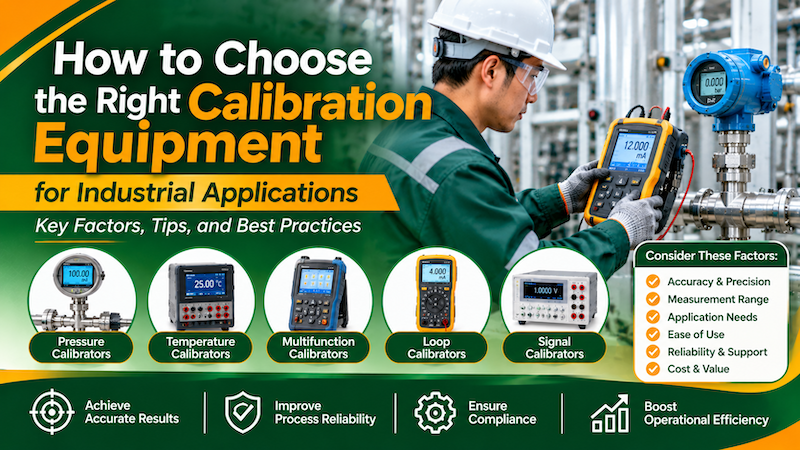
Selecting the right calibration equipment is a critical decision for any industrial facility that depends on accurate measurement. Pressure gauges, transmitters, thermocouples, and temperature sensors all require periodic verification to ensure process safety, product quality, and regulatory compliance. With so many calibration technologies available, choosing the right equipment requires a clear understanding of your measurement range, accuracy requirements, application environment, and long-term maintenance strategy. This guide explains the key factors to consider when selecting calibration equipment for industrial applications.
1. Define Your Measurement Parameters and Range
The first step is to identify exactly what you need to calibrate. Pressure and temperature are the two most common parameters in industrial calibration programs, but the required range, resolution, and accuracy vary widely between applications. A low-pressure HVAC sensor and a high-pressure hydraulic system require very different calibration tools. Always select equipment whose range covers your instruments with some margin, and check the accuracy specification is at least four times better than the device under test.
2. Choose the Right Pressure Calibration Technology
Pressure calibration equipment comes in several forms, each suited to different accuracy levels and workflows.
Deadweight Testers for Primary Pressure Standards
Deadweight testers generate pressure using calibrated weights and a precision piston-cylinder assembly. They are considered primary standards because their accuracy is based on fundamental physical principles. These instruments are ideal for laboratories, high-accuracy calibration of pressure gauges and transmitters, and applications where traceability is critical. Explore the full range of Deadweight Testers for laboratory and high-precision calibration needs.
Gauge Comparators for Fast Field Calibration
Gauge comparators allow you to compare a test gauge against a reference gauge using a simple pressure source. They are practical for routine calibration and verification of pressure gauges in workshops and field environments, offering a good balance between accuracy and convenience. Browse the Gauge Comparators collection for practical comparison-based calibration setups.
Pneumatic Pressure Calibrators for Safe, Clean Testing
Pneumatic pressure calibrators use compressed air or nitrogen to generate pressure, making them ideal for low-to-medium pressure ranges and environments where hydraulic fluid would be undesirable. They are common in food and beverage, pharmaceutical, and clean manufacturing applications. Discover reliable Pneumatic Pressure calibrators for safe and clean pressure testing.
3. Select Temperature Calibration Equipment for Your Sensors
Temperature sensors such as RTDs, thermocouples, and temperature transmitters require stable and uniform temperature sources for accurate calibration. Dry-block calibrators offer fast heating and cooling with excellent portability, while liquid-bath calibrators provide superior uniformity for laboratory work. Consider the temperature range, stability, and uniformity requirements of your sensors, and whether you need a portable unit for field service or a benchtop system for the calibration lab. Browse the complete Temperature Calibrators range to find the right solution for your sensor types.
4. Consider Accuracy, Stability, and Traceability
Calibration equipment must be more accurate than the instruments it verifies. A common rule is a test uncertainty ratio (TUR) of at least 4:1 between the calibration standard and the device under test. Also check stability specifications, warm-up times, and whether the equipment can provide traceable calibration certificates through an accredited laboratory. Traceability is essential for quality management systems such as ISO 9001 and for regulated industries.
5. Match Equipment to the Working Environment
Industrial environments vary greatly. Field service technicians need portable, rugged, and battery-powered calibration equipment, while calibration laboratories require benchtop instruments with high stability and automation features. For hazardous areas such as oil and gas facilities, intrinsically safe or explosion-proof models are mandatory. Consider temperature and humidity limits, ingress protection ratings, and ease of transport when selecting equipment.
6. Evaluate Usability, Automation, and Documentation
Modern calibration equipment often includes automated test routines, digital displays, data logging, and certificate generation. These features reduce human error, speed up calibration procedures, and simplify record-keeping for audits. If your team performs a high volume of calibrations, investing in equipment with automation and documentation capabilities can significantly improve efficiency.
7. Plan for Long-Term Support and Maintenance
Calibration equipment itself requires periodic recalibration and maintenance. Choose equipment from reputable brands with local service support, readily available spare parts, and clear recalibration intervals. A trusted supplier can help you plan calibration schedules, provide technical support, and ensure your standards remain within specification year after year.
8. Source Genuine Calibration Equipment from a Trusted Supplier
Genuine calibration equipment from authorized channels ensures accuracy, safety, and long-term reliability. Counterfeit or poorly maintained instruments can introduce measurement errors that compromise your entire quality system. Nani Rohaeti, based in Batam, Indonesia, supplies a comprehensive range of calibration instruments, including deadweight testers, gauge comparators, pneumatic pressure calibrators, and temperature calibrators from leading brands such as Fluke, Druck, Ametek, WIKA, and Crystal Engineering. With competitive pricing and fast delivery across Indonesia and Southeast Asia, Nani Rohaeti is a reliable partner for your calibration program.
Quick Checklist for Choosing Calibration Equipment
- Identify measurement parameters, ranges, and required accuracy.
- Confirm the test uncertainty ratio (ideally 4:1 or better).
- Select the appropriate pressure technology: deadweight, comparator, or pneumatic.
- Choose temperature calibrators based on sensor type and range.
- Check portability, environmental ratings, and hazardous area certification.
- Evaluate automation, data logging, and certificate generation features.
- Verify traceability and accredited calibration availability.
- Purchase genuine equipment from an authorized supplier with local support.
Conclusion
Choosing the right calibration equipment requires a balance of accuracy, practicality, and long-term support. By understanding your measurement requirements and selecting the appropriate technology—whether deadweight testers, gauge comparators, pneumatic pressure calibrators, or temperature calibrators—you can build a calibration program that protects product quality, ensures safety, and satisfies regulatory requirements. Investing in genuine, high-quality calibration equipment from a trusted supplier is an investment in the reliability of your entire measurement system.